


Hybrid Vehicle Diagnostics in the Workshop: What You Need to Add to Your Equipment
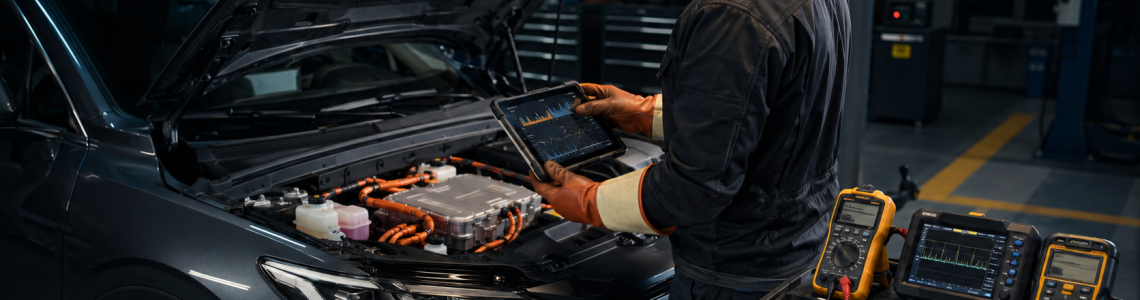
Hybrid vehicle diagnostics requires more than a standard OBD scanner and multimeter. In addition to a diagnostic tester with genuine HEV/PHEV coverage, the workshop needs CAT III 1000 V-rated measuring equipment, an insulation resistance tester, equipment for HV battery analysis, an oscilloscope, insulated tools and appropriate personal protective equipment – together with trained personnel for working on high-voltage systems.
Hybrid vehicles are becoming an increasingly common part of the daily work of independent workshops. However, hybrid vehicle diagnostics requires more than a standard OBD scanner and multimeter. In addition to conventional ECU systems, there is a high-voltage battery, inverter/converter, electric motor-generators, DC/DC converter, power contactors, Battery Management System (BMS) and, in plug-in hybrids, charging components.
Modern HEV/PHEV powertrains typically operate within a range of around 400–800 V – voltages that are potentially lethal and require a completely different approach to safety and measurements compared with the 12-volt on-board electrical system.
For the workshop, this means both new diagnostic equipment and a different approach to safety and measurements.
1. Diagnostic Tester With Genuine HEV/PHEV Coverage
The first step is a diagnostic platform that supports not only the engine and standard chassis modules but also the specific ECU systems of the hybrid powertrain.
When performing hybrid vehicle diagnostics, you need to be able to access parameters such as:
State of Charge (SOC) and State of Health (SOH);
voltage of individual battery modules/cells;
voltage difference between the modules;
temperatures within the HV battery;
status of the main contactors;
inverter and motor-generator parameters;
isolation faults and DTC codes from the BMS.
Modern diagnostic solutions already allow SOC/SOH assessment and assist with procedures for making the high-voltage system safe.
2. Multimeter for High-Voltage Systems
A standard automotive multimeter is not always suitable for working on an HV system. The measuring instrument, probes and accessories must have a rating corresponding to the voltage and measurement category of the specific procedure.
For automotive HV applications, measuring solutions with a CAT III 1000 V rating are used, for example. The measurement category (CAT) is not a formality – it determines the instrument’s ability to withstand transient overvoltages in the relevant part of the system. Using an underrated instrument presents a risk both to the instrument and to the technician. Properly rated instruments can be used to check for the presence or absence of voltage after the high-voltage system has been correctly disconnected.
Important: the specific procedure for deactivating the system and confirming a safe state must always follow the vehicle manufacturer’s requirements.
3. Insulation Resistance Tester
One of the significant differences with HEV/PHEV vehicles is the need to diagnose the insulation between the high-voltage system and the chassis. A damaged cable, HV component, connector or the battery itself can result in reduced insulation resistance and the vehicle registering an isolation fault.
Specialized HV insulation testers apply a test voltage (typical ranges are 250 V, 500 V and 1000 V) and measure the insulation resistance, allowing such problems to be located and assessed. Moisture and contamination on powertrain components are common causes of reduced insulation, which makes this test particularly informative for electrified vehicles. Bosch, for example, offers dedicated equipment for testing the insulation of HV batteries and components specifically for workshop diagnostics of electrified vehicles.
4. Equipment for HV Battery Analysis
For more in-depth hybrid vehicle diagnostics, simply reading a DTC code is not enough.
Professional battery diagnostic solutions can analyze pack voltage, individual module voltages, temperatures, SOC/SOH and voltage delta. Some systems even allow offline diagnostics of a removed battery pack through specialized adapters.
This is particularly valuable when searching for a degraded module or uneven battery behaviour – a common cause of reduced performance or warnings, without the entire battery necessarily requiring replacement.
5. Oscilloscope and Additional Measuring Equipment
The oscilloscope remains an important tool for electrified vehicles as well. It allows the analysis of communication lines, sensors, control signals and other electrical values when standard ECU diagnostics does not provide sufficient information. Differential probes with an appropriate rating are used for measurements directly on high-voltage circuits. Bosch, for example, combines ECU diagnostics with measuring systems and a high-performance oscilloscope specifically for more complex automotive electrical faults.
Equipment Is Only Half of the Preparation
Work on a high-voltage system also requires appropriately trained personnel, a designated work area, insulated tools and personal protective equipment according to the specific procedure.
For tools, an industry benchmark is the IEC 60900 standard – hand tools for live working up to 1000 V AC / 1500 V DC. For personal protective equipment, Class 0 insulating gloves are essential (under IEC/EN 60903, rated for 1000 V AC / 1500 V DC), which cover the typical operating voltages when working on automotive HV systems. These gloves are worn together with outer leather protective gloves to prevent mechanical damage and are subject to periodic inspection and retesting (the industry practice is every 6 months). Depending on the procedure, a protective face shield/safety glasses, an insulating mat and signs warning others in the workshop of the presence of high voltage may also be required.
HELLA emphasizes the need for specialized qualifications for working on HV vehicles, while Bosch training includes the safe deactivation and diagnostics of high-voltage systems.
The Principle of Safe Deactivation in Brief
Before working on an HV component, the general process – always following the procedure of the specific manufacturer and carried out by a trained technician – includes disconnecting and securing the high-voltage system through the relevant service disconnect, confirming a safe, de-energized state with a properly rated measuring instrument and marking the vehicle to prevent accidental re-energization by another employee. This article describes the principle for guidance only and does not replace an official workshop procedure or training.
Are You Preparing Your Workshop for Hybrid Vehicle Diagnostics?
CarHack can help you build the right configuration of diagnostic and measuring equipment according to the vehicles and services you plan to support.
Contact CarHack for professional hybrid vehicle diagnostic equipment and to develop your workshop toward HEV/PHEV servicing.
Frequently Asked Questions
Can a Regular OBD Scanner Be Used for Hybrid Vehicles?
A standard OBD scanner can read generic DTC codes but does not provide access to hybrid-specific systems – BMS, inverter, motor-generator, SOC/SOH, contactor status and isolation faults. Genuine HEV/PHEV diagnostics requires a platform with coverage of these modules.
What Type of Multimeter Is Required for Working on an HV System?
A measuring instrument with a category and rating appropriate for the procedure is used – typically CAT III 1000 V for automotive HV applications, together with appropriately rated probes and accessories. Checking for the presence or absence of voltage is carried out after the system has been correctly disconnected, following the manufacturer’s procedure.
What Does an Insulation Resistance Tester Measure and Why Is It Important?
An insulation resistance tester checks the insulation resistance between the high-voltage system and the chassis by applying a test voltage (usually 250 / 500 / 1000 V). Reduced insulation – caused by a damaged cable, connector, component or moisture – leads to an isolation fault and is among the characteristic faults found in electrified vehicles.
What Personal Protective Equipment Is Required for Working on a Hybrid?
Class 0 insulating gloves (1000 V AC / 1500 V DC) are essential, worn with outer leather protective gloves and subject to periodic inspection. Depending on the procedure, face/eye protection, an insulating mat, work-area signage and insulated tools compliant with IEC 60900 are also added. The exact set of equipment is determined by the manufacturer’s workshop procedure.
Is Special Training Required for Hybrid Vehicle Diagnostics?
Yes. In addition to the equipment, work on high-voltage systems requires trained and qualified personnel. Manufacturers and training programmes (such as Bosch and HELLA) emphasize the safe deactivation and diagnostics of HV systems as a prerequisite for carrying out this type of work.