


bFlash Master or Slave: Which Option Fits Your Workshop?
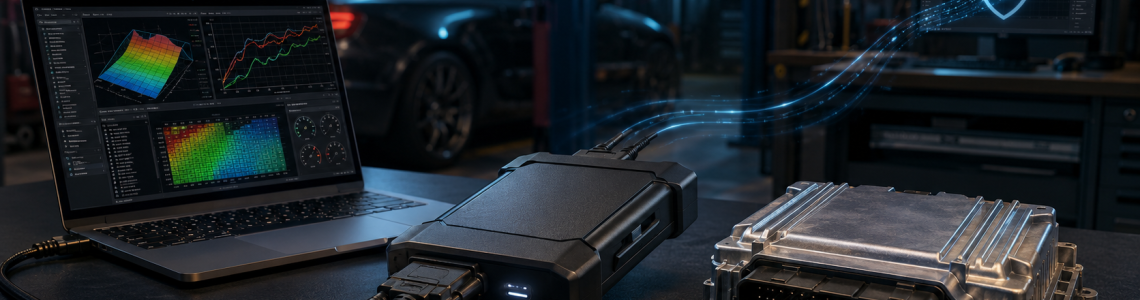
bFlash Master works with unencrypted files, includes Real-Time Tuning and can manage its own network of Slave devices – it is suitable for workshops that develop calibrations themselves. bFlash Slave works with encrypted files linked to a specific Master and is intended for workshops that offer chip tuning with ready-made files, without their own calibration department.
When choosing a professional ECU/TCU programmer, the technical capabilities are only one side of the decision. Equally important is how the workshop works with the files, who performs the calibration and how independent you want to be from an external tuning provider. This is precisely why the choice between bFlash Master or Slave should begin with your workshop’s business model.
Both options use the same bFlash ecosystem and offer work with ECUs and TCUs via OBD, Bench and Boot, datalogging, DTC diagnostics, CAN Bus recording and automatic checksum correction during writing. The main difference lies in access to the tuning file itself and control over the calibration process.
bFlash Master – When You Want Full Control Over the Calibration
bFlash Master reads and writes tuning files in unencrypted form. This means that the file can be opened and edited with suitable calibration software, and the calibrator is not tied to a specific Master or a single file provider.
This option is suitable for workshops that develop their own Stage 1, Stage 2 or custom calibrations, work on a dyno or have their own calibration engineer.
The Master version also includes Real-Time Tuning, which allows changes to certain calibration parameters to be tested in real time on supported ECU platforms. This can significantly optimize the process of developing and validating an individual remap. This feature is one of the main differences between the two options: Master has six functions (high-speed flashing, basic and advanced datalogging, diagnostics, real-time tuning, CAN Bus recording and datalogging review), while Slave includes the same functions but without real-time tuning.
In addition, one Master can be used as the foundation for a network of bFlash Slave devices. This is particularly suitable for tuning companies that provide files to partner workshops or build their own dealer model. To manage this network, bFlash also provides every Master with an Encrypt/Decrypt portal, through which .BDC files can be encrypted into ready-to-use Slave .SBDC files directly from the operator’s account – remotely, even without the bFlash device at hand, with the option to set a validity period for the encrypted file.
bFlash Slave – When the Calibration Comes From Your Master
With bFlash Slave, ECU/TCU files are read and written in encrypted form, and each Slave device must be linked to a bFlash Master. The read file is sent to the Master operator, who performs the necessary modification and returns a protected file for writing.
This makes Slave suitable for workshops that want to offer chip tuning but do not develop ECU/TCU calibrations independently.
The workshop can perform the identification, read/write procedure, datalogging and diagnostics on-site, while the more specialized work on the file remains with the selected Master tuner.
It is important to note that the hardware of the Master and Slave devices is identical – the difference lies in the software permissions and file encryption, not in the hardware platform itself. Therefore, a later upgrade from Slave to Master is possible without replacing the device.
You Are Not Dependent on Only One Provider
One of the common questions regarding the Slave configuration is the extent to which the workshop remains tied to a single Master. In practice, bFlash supports multi-master scenarios: with the consent of the respective Master operators, one Slave device can work with more than one Master. For example, a VAG specialist can allow their Slaves to purchase files for other brands from another Master, and if the primary Master is temporarily unavailable (holiday, workload), the Slave can be switched to an alternative provider. This reduces the risk of dependence on a single source of files.
File Formats: .BDC, .SBDC and .MDF
The difference between the two options is also clearly visible at file level:
.BDC
Master file – contains all ECU/TCU memory elements in a single, unencrypted file
.SBDC
Slave file – the same content, but encrypted; only the specific Slave can program it
.MDF
Standard datalog file (Measurement Data Format); can be opened in compatible software
The unencrypted .BDC format is the reason why Master provides complete freedom for editing, while the encrypted .SBDC protects the calibrator’s intellectual property – the Slave device can write the file but cannot open or modify it.
bFlash Master vs Slave Comparison
bFlash Master
Files: Unencrypted (.BDC)
Who performs the calibration: The workshop / in-house calibrator
Real-Time Tuning: Yes
Number of functions: 6
Own Slave network: Yes
OBD / Bench / Boot, datalogging, DTC, CAN Bus recording, checksum: Yes
Suitable for: Development of Stage 1/2/custom calibrations, dyno work
Upgrade: None
bFlash Slave
Files: Encrypted (.SBDC), from a linked Master
Who performs the calibration: External Master tuner
Real-Time Tuning: No
Number of functions: 5
Own Slave network: No
OBD / Bench / Boot, datalogging, DTC, CAN Bus recording, checksum: Yes
Suitable for: Workshop operations using ready-made files
Upgrade: Can be upgraded to Master
bFlash Master or Slave – How to Choose?
In practice, the decision comes down to the question of who will create the tuning file.
If you have your own calibrator, use WinOLS or other professional calibration software, develop custom solutions or plan your own Slave network, bFlash Master offers the necessary independence.
If your main business is workshop services and you want to add ECU/TCU tuning without building your own calibration department, bFlash Slave allows you to work with files prepared by your Master.
It is also important to consider the ongoing operational cost – both Master and Slave require an active bFlash subscription to operate. The purchase price usually includes an initial subscription period, after which renewal takes place at a selected interval (for example, 1, 3, 6 or 12 months). bFlash also offers an official option for a Slave device to be upgraded to Master at a later stage if the needs of the business evolve. When reselling or changing the owner of a Slave device, consent from the current Master is also required – a detail that should be taken into account when planning a dealer network.
Frequently Asked Questions About bFlash Master and Slave
What Is the Main Difference Between bFlash Master and Slave?
Master works with unencrypted files (.BDC), allows in-house calibration development and management of a network of Slave devices. Slave works with encrypted files (.SBDC) that come from a linked Master and is intended for workshops that offer tuning with ready-made files without developing them themselves.
Does the Slave Version Include Real-Time Tuning?
No. Real-Time Tuning is available only in the Master version. Slave includes the remaining functions – high-speed flashing, basic and advanced datalogging, diagnostics, CAN Bus recording and datalogging review.
Can Slave Be Upgraded to Master?
Yes. The Master and Slave hardware is identical, so a Slave device can officially be upgraded to Master if the business needs evolve, without replacing the device itself.
Is an Active Subscription Required for bFlash to Work?
Yes. Both Master and Slave require an active bFlash subscription. An initial period is usually included with the purchase, after which the subscription is renewed at a selected interval. This is an ongoing operational cost that should be included when calculating the service price.
Can One Slave Device Work With Several Masters?
Yes, bFlash supports multi-master scenarios with the consent of the respective Master operators. This allows one Slave to receive files for different brands from different providers or to switch to a backup Master if the primary one is temporarily unavailable.
Not Sure Which bFlash Is Right for Your Workshop?
CarHack can help you choose between bFlash Master or Slave according to the services you offer, the volume of vehicles and the way you want to organize your ECU/TCU tuning process.
Contact CarHack for a consultation and assistance in choosing the right bFlash configuration for your business.