


Autotuner vs Flex vs KESS3 – The Ultimate Comparison
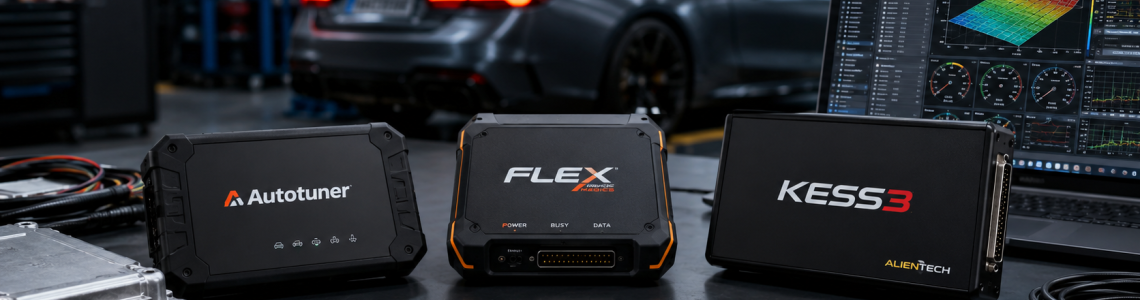
Choosing a professional ECU and TCU programming tool is not simply a matter of price. The decision determines which vehicles a workshop can service, which access methods it can use, how quickly it can complete each job, and how much risk it assumes when working with modern control units.
That is why the Autotuner vs Flex vs KESS3 comparison is one of the most frequently discussed topics among chip tuning professionals.
All three tools are designed for working with ECU and TCU modules and support the main reading and writing methods: OBD, Bench, and Boot. However, the difference is not limited to what they can do. It also lies in how they perform these operations, their software ecosystems, vehicle coverage, and the business model behind each platform.
Here is a practical Autotuner vs Flex vs KESS3 comparison based on the criteria that matter when purchasing a professional tuning tool.
Autotuner – Speed, Convenience, and a Streamlined Workflow
Autotuner is preferred by many workshops because of its clear interface, fast identification process, and relatively straightforward workflow. It is designed for professional ECU and TCU reading and writing without making the process unnecessarily complicated.
Autotuner’s main strength is its practicality. In day-to-day operations, when a workshop handles different vehicles and needs a fast, stable, and predictable procedure, this can make a significant difference. The device is particularly convenient for teams that want to minimise the time between vehicle identification, extraction of the original file, and submission of that file for calibration.
It is important to clarify that Autotuner is not file-editing software. It is used to read, write, and communicate with control units, while the actual calibration is performed with separate software or by a professional file service.
This makes Autotuner highly suitable for workshops that do not develop every calibration in-house but still require a reliable tool for safely extracting and writing files.
Flex – A Powerful Ecosystem for Advanced ECU and TCU Work
Flex by Magicmotorsport is aimed at workshops and specialists looking for a broader ecosystem and more advanced interaction with electronic control units. It also supports OBD, Bench, and Boot modes, but stands out because it is part of a complete professional environment that includes hardware, software, technical resources, services, and support.
Flex is a strong choice for workshops that perform not only remapping but also more complex operations, such as control unit recovery, cloning, bench work, and resolving specific ECU or TCU issues.
This makes it suitable for technically oriented teams that are not simply looking for a flasher, but for a tool capable of supporting more advanced automotive electronics work.
In the Autotuner vs Flex vs KESS3 comparison, Flex is often positioned as the preferred option for workshops that require flexibility and technical depth. It may demand a higher level of technical knowledge, but in return it provides greater control over the entire workflow.
KESS3 – The Successor to KESSv2 and K-TAG in One Tool
KESS3 is Alientech’s new-generation platform, combining the philosophy of two well-known tools: KESSv2 for OBD operations and K-TAG for Bench and Boot work.
With KESS3, Alientech has moved towards a more modern model in which a single hardware device can support different communication methods and multiple vehicle categories.
The main advantage of KESS3 is its combination of familiar operation, a well-established brand, a broad protocol database, and a professional Master/Slave structure.
This makes it a popular choice for both independent tuning specialists and workshops that operate through a partner network or use external file providers.
KESS3 is particularly suitable for users who are already familiar with the Alientech environment or who need a long-term solution with clearly structured protocol categories, including cars and light commercial vehicles, motorcycles, trucks, agricultural machinery, and marine applications.
Licensing Model – The Most Significant Practical Difference
Autotuner operates without a mandatory annual fee. You purchase the device with the included protocols and receive updates without a subscription.
This is its strongest commercial advantage: a predictable, one-time investment.
KESS3 by Alientech uses a subscription-based model. Its protocols are divided into category packages, such as:
Cars and light commercial vehicles via OBD
Bench and Boot
Trucks
Agricultural machinery
Marine applications
Each package is activated separately and requires annual renewal to maintain access to new protocols. For users requiring full coverage, the annual cost can be substantial and should be included in the workshop’s business plan.
Flex by Magicmotorsport sits somewhere in between. It uses a modular structure in which licences are purchased by category, such as OBD, Bench and Boot, or specific modules, with a subscription for updates.
This allows users to begin with only the functionality they need and expand the system over time.
Coverage and Technical Capabilities
For standard OBD, Bench, and Boot operations on passenger vehicles, all three tools offer comparable capabilities. Bosch MED17 and EDC17, as well as Continental and Delphi control units, are supported across all three platforms.
The main differences become apparent in more specialised situations.
KESS3 offers the broadest coverage across vehicle categories. It is the only one of the three platforms with comprehensive support for trucks, agricultural machinery, motorcycles, and marine applications.
For a workshop that works with agricultural machinery from manufacturers such as John Deere, New Holland, or Case, this may effectively determine the final choice.
Flex provides the greatest depth for complex operations, including control unit recovery, cloning, and bench work on TCU modules such as ZF 8HP and DSG. It can also handle situations in which standard Boot access is not sufficient.
For workshops specialising in controller repair and cloning rather than remapping alone, this can be a decisive advantage.
Autotuner offers the fastest everyday workflow for identification, reading, and writing on widely used control units. It also has the cleanest and most streamlined interface of the three.
Its coverage of newer Bosch MG1 and MD1 units continues to expand and remains among the leading options on the market.
Master/Slave Structure
All three platforms offer a Master/Slave model, but under different conditions.
With Autotuner and KESS3, a Slave device is linked to a specific Master. Changing the Master requires an official procedure handled through the manufacturer.
Flex uses a similar structure, although its modular licensing model can make the initial investment in a Slave device more flexible.
For a workshop planning to build its own dealer or partner network, KESS3 offers the most established and widely recognised Master/Slave ecosystem on the market. This can be an important factor when recruiting partners.
One important clarification applies to all three tools: none of them is designed for editing files.
Calibration is performed using software such as WinOLS or ECM Titanium, or through a professional file service. The flasher itself is used to read and write the file.
Which Tool Is Best for Each Type of Workshop?
A workshop processing approximately 20–40 files per month, mainly for passenger vehicles and using an external file service, will often benefit most from Autotuner.
It offers a fast setup, no annual subscription, and a minimal learning curve.
A technical team specialising in ECU and TCU repair, cloning, and recovery will generally be better suited to Flex.
Its advanced Bench capabilities and strong TCU support can justify the more complex environment.
A workshop handling a diverse vehicle fleet, including trucks, agricultural machinery, and motorcycles, or planning to establish a Slave network, will usually benefit most from KESS3.
Its broad vehicle coverage and proven Master/Slave structure can offset the ongoing subscription costs.
There is no universal winner. There is only the right tool for a specific business model.
The most expensive mistake is not the purchase price of the device. It is choosing a platform that, one year later, no longer supports the direction in which your business is developing.
Choose the Right Tool for Professional Tuning
Whether you are deciding between Autotuner, Flex, or KESS3, the most important factor is selecting a tool that matches the real requirements of your workshop: the vehicles you service, the level of technical complexity you handle, and the direction in which you want to grow.
At CarHack.net, you will find professional solutions for ECU and TCU programming, chip tuning, diagnostics, and working with modern automotive control units.
Explore the available tools and choose equipment that allows you to work more safely, more efficiently, and at a truly professional level.